
On Sunday, May 17th, the Rea Valley Community Wildlife Group headed out for what was billed as the Buxton Hill stroll. The plan was to wander near Buxton Hill and Wood, where the Stiperstones quartzite ridge meets the historic Tankerville mining area. While we oohed and aahed at the impressive views, mostly we had our eyes glued to the ground, hunting for the plants and insects that call this valley home.
Buxton Wood was covered in bluebells, looking like clouds of blue smoke drifting through the trees. This fleeting spectacle is repeated in woodland across the Rea Valley at this time of year and well worth trying to see.
A big thank you to Anne, who kindly got permission for us to access a couple of wildflower meadows at Hogstow. We all wished we owned this patch of land near the headwaters of the Minsterley Brook. A public footpath ran through one corner, but we were able to wander around the edge of these undisturbed meadows.
Jill told us that while The Buxton Hill stroll was full of spring delights, the highlight was spotting a large number of Marsh Marigold pollen moths in the buttercups at Hogstow meadows. Groups of 4 or 5 of these tiny metallic golden moths could be seen jostling and wing-flicking in the flower heads, with singles scattered around in buttercup flower heads and on stems. These moths are of interest because pollen moths are representatives of a very ancient group of butterflies and moths which still have jaws in the adult stage, all the other groups have evolved a proboscis and sip nectar and other liquids. Pollen-moths nibble pollen (hence the common name), and there are only 5 species in the UK of which 3 can be found in Shropshire.
Other wildlife of note included Green Longhorn moths, a Grass Rivulet moth, four species of soldier beetles, plus Green-winged and Early orchids.
Kat tried to teach us how to spot different vetch species, using fun visual clues like ‘eggs on a shelf’. But with lunchtime approaching, it just made everyone hungry – Kat realising we all needed more practice before we could call ourselves apprentice botanists!
We heroically passed up on a quick visit to the Stiperstones Inn, and instead headed up Perkins Beach Dingle. Crossing over to the darker, damper moss and fungi covered side of the valley, we followed the contours through more woodland. Occasional breaks in the trees allowed for some hill spotting. The Breiddens just over the border in Wales were easily recognisable, plus various more distant Welsh mountains. Then after a few wrong turns, we finally tumbled back onto the main road just below the car park where we met John Kean.
John and his wife Cheryl own land at Tankerville which they manage as a forest garden. Forest gardening is a low maintenance system of growing food that harnesses the natural diversity and ecosystems found in woodlands and forests. Annual vegetable growing is replaced by utilising perennial plants.
In the top canopy of a forest garden trees such as walnuts ,Sweet Chestnuts and fruit trees are grown. The middle canopy is populated by nut trees such as Hazel and fruits such as plums or medlars. The lowest tier of the forest garden is formed of fruit bushes such as Goosberries, Raspberries and other soft fruit. John explained all of this to us on our tour and also showed how he has planted trees that nourish the soil such as Italian Alder whose roots fix nitrogen. Comfrey (Boking 14), is grown for its ability to draw up minerals from deep down, with its extensive tap roots. John explained that the comfrey is “chopped and dropped” on an annual basis to further provide nutrients to the plants in the forest garden system. John and Cheryl harvest their wide range of fruit and nuts, which they store for the winter. Harvesting hazelnuts before they are fully ripe prevents the grey squirrels from consuming most of the crop. The nuts store well once dried providing a valuable source of protein.
John and Cheryl’s system of agriculture also provides a fantastic habitat for all sorts of fauna that share their hillside property. A really interesting tour and a fascinating glimpse into an alternative, sustainable method of producing food.
Thanks to John and Cheryl Keen for taking time to show us around. Write up contributions from J.Livsey, J.Key and S.Wallace-Johnson
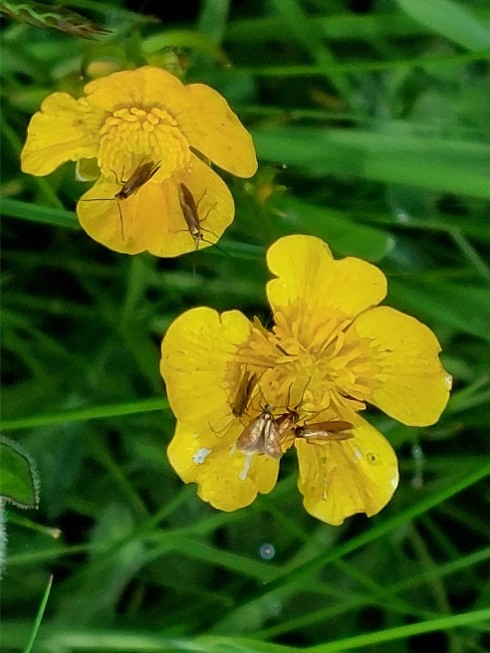
Pollen Moths