This event was led by Ben Holloway (RVCWG Chair), Kat Edwards-White (RVCWG Secretary) and Laura Edwards-White (RVCWG Committee Member).
A huge thank you to Siobhan Reedy (RVCWG Committee Member) for enabling us to hold this event in her garden and pond area.
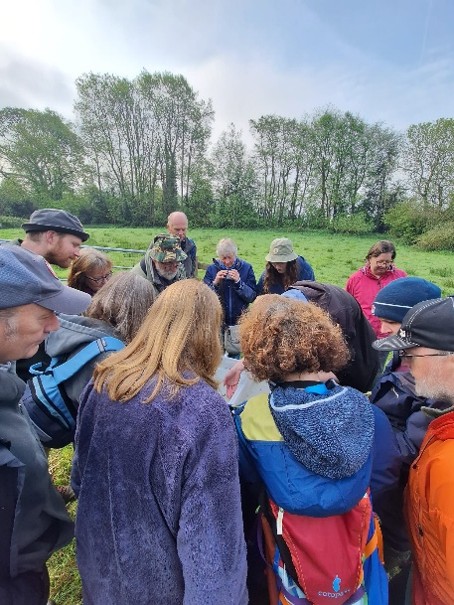
The early start didn’t put people off, as a group of 10 gathered in Habberley at 7.30am with the hope of seeing some moths and newts. The weather had been mixed during the week, with overnight rain and low temperatures, but fortunately the night before the event had been relatively dry, and temperatures were higher than expected which made us hopeful for what we might see.
The group walked to Siobhan’s patio area where Kat and Laura introduced the world of moth recording to the group and showed everyone a moth light trap and explained how they work. Moth light traps are used as a tool to attract moths and temporarily hold them so that the moths can be identified before releasing back into the wild unharmed. It’s a great way to see which moth species are using your garden throughout the year. They typically consist of a bright ultraviolet or actinic bulb suspended over a funnel which guides the moths into a safe collection chamber which is lined with eggs boxes for them to rest overnight. The traps are checked at first light the next morning before the temperatures increase. The moths can be released straight away into nearby vegetation or temporarily put into pots to have a closer look at them. Sightings from a moth trap can easily be recorded on iRecord.
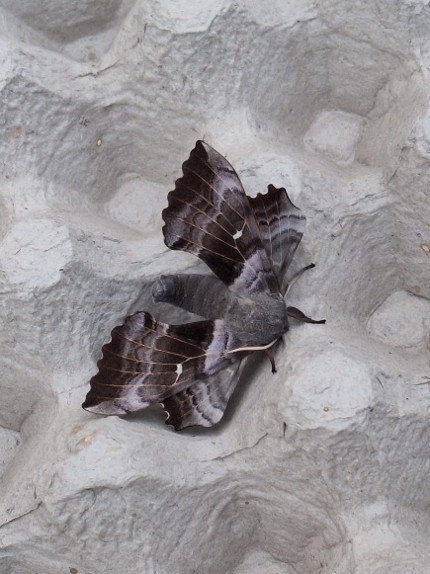
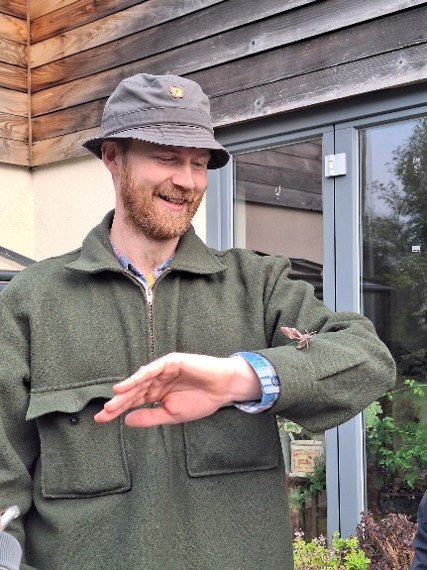
The evening before the event, Kat and Laura had put out two moth light traps, one in Minsterley and one in Habberley. Everyone gathered around the moth trap that had been in Habberley overnight and as a group we looked at the moths that were resting on the egg boxes inside. The huge Poplar Hawkmoth was a surprise for everyone. There were another 4 species hiding amongst the egg boxes, a Muslin Moth, Nut-tree Tussock, Brimstone Moth and a Powdered Quaker.
The moth trap in Minsterley was emptied at dawn before the event and the moths temporarily placed in pots. The pots were brought to Habberley and passed around the group so that everyone was able to see the variety of species such as the Eyed Hawkmoth, Swallow Prominent, Peppered Moth, Pale Tussock, and the Small Ranunculus. People were able to take a closer look at the different sizes, shapes and colours of the variety of species. All moths caught in the Minsterley moth trap were returned to Minsterley unharmed after the event.
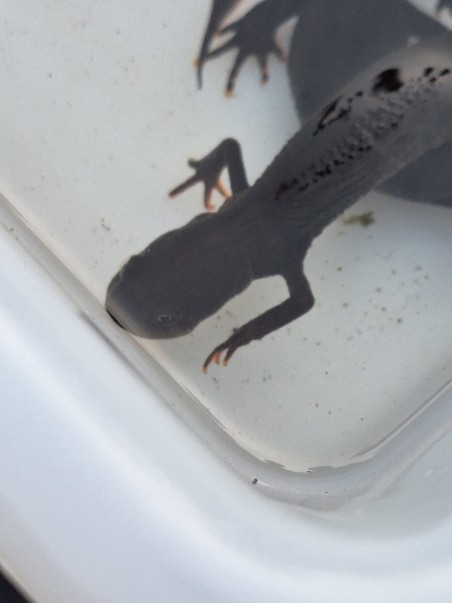
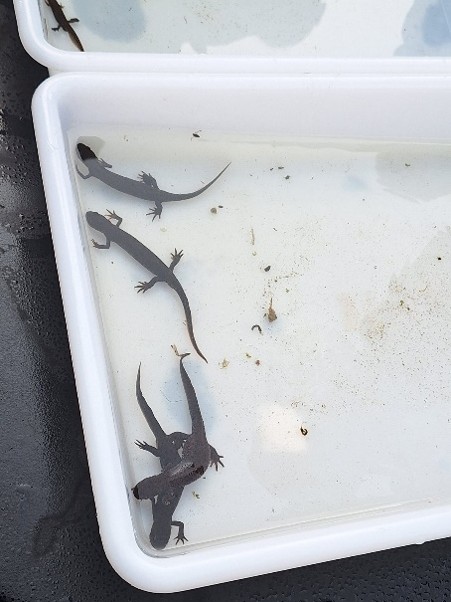
After taking a look at the moths caught overnight, the group moved up the road and through a meadow to one of Siobhan Reedy’s ponds. Ben holds a Great Crested Newt (GCN) Protected Species Licence from Natural England, allowing him to trap and handle GCN. Bottle traps had been set in the pond overnight and the trapped newts were out in trays on a table for the group to see. With four female GCN caught, their presence in Siobhan’s pond were confirmed once again. Smooth Newt and Palmate Newt were also captured, meaning that all three native species of newt are present within the pond. Reflecting well on Siobhan’s hard work caring for the waterbody! Discussion about the newts, the pond and amphibians in general ensued but soon it came time for the newts to be let back into the water.
Heading back to Siobhan’s garden the group gathered for some final moth viewing before making their way home once again; leaving Kat, Laura, Siobhan and Ben some time to clear up and relax after their early morning start!